
There’s a moment every Minnesota household knows. It’s mid-January, everyone comes in the back door at once, and within ninety seconds the entry has disappeared under six boots, four coats, two backpacks, a pair of snow pants, and a hockey bag that somehow smells worse than last week.
In warmer states, a mudroom is a design flourish. Here, it’s infrastructure.
The good news: this is one of the most fixable problems in the whole house. An entry that fails in winter is almost never too small. It’s almost always undesigned. Here’s what works in Twin Cities homes.
Start With the Real Inventory, Not the Average One
Most entry storage is sized for a normal day. Minnesota doesn’t have normal days. It has February.
Before designing anything, count your peak load, not your typical one:
- One heavy parka per person, plus a lighter transitional jacket that’s still in rotation
- Two pairs of boots per person (the warm pair and the wet pair)
- Snow pants, and where they go when they’re soaked
- Hats, gloves, and neck gaiters, which multiply and which nobody ever pairs
- Bags: backpacks, gym bags, hockey and skate bags, ice fishing gear
- The guest overflow, because people visit in December
If your entry holds all of that on the worst day of the year, it will feel luxurious the other eleven months.
Give Every Person a Zone
The single highest-impact change we make in Minnesota entries is switching from a shared rod to individual lockers.
A locker per family member, even a narrow 15-inch one, does something a shared closet can’t: it makes the mess assignable. Kids can hang their own coat when the hook is at their height and it’s clearly theirs. Nothing gets buried under someone else’s parka.
A working locker has four parts:
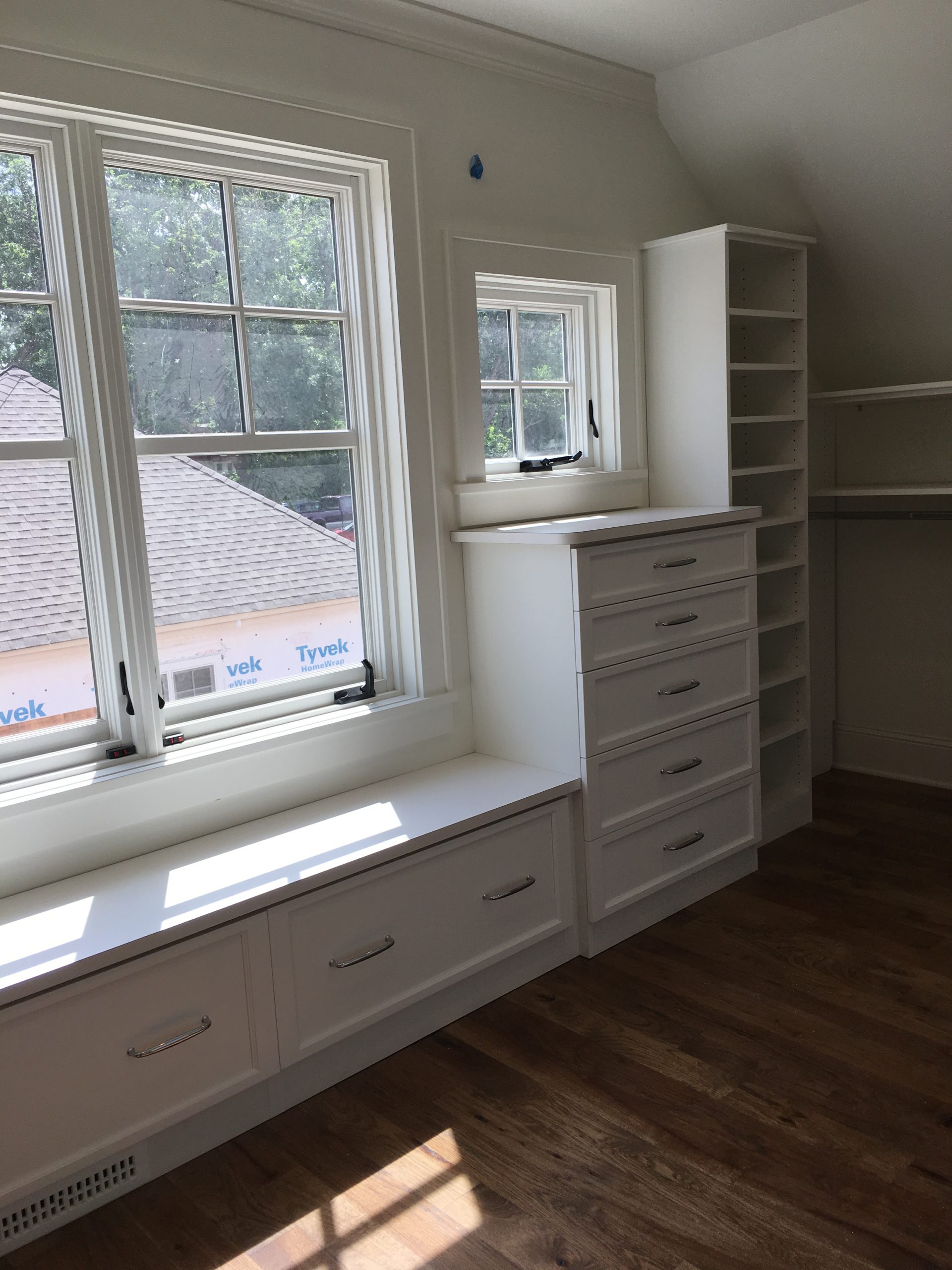
- A bench at sitting height, because you cannot put on winter boots standing up
- Boot storage underneath, open and ventilated, not a closed box
- A double hook at the right height for that person, because coats need hooks, not hangers, in a mudroom
- A shelf above for hats, gloves, and the bin that catches the small stuff
Design for Wet, Not Just for Full
This is the part national closet systems consistently get wrong. Minnesota gear doesn’t just need to be stored. It needs to dry, or you get mildew, rust, and a smell you can’t chase out.
What we specify locally:
- Open or mesh-front boot storage. Airflow matters more than concealment. A closed cabinet full of wet boots is a science experiment.
- A boot tray with a real lip. Melting snow carries road salt, and salt destroys finishes and flooring.
- Moisture-resistant materials at the bottom 18 inches. Thermofoil or a quality laminate on lower surfaces instead of raw wood edges.
- A dedicated drip zone for snow pants and wet gloves, ideally over a hard floor, not carpet.
- Heated floors if you’re already renovating. It’s the single best boot-drying feature there is, and it costs far less when it’s part of an existing project.
If You Don’t Have a Mudroom
Most homes in Minneapolis and St. Paul weren’t built with one. That’s fine. A mudroom is a function, not a room.
We regularly build one out of:
- The back entry landing. Even 30 inches of wall on the way in from the garage supports a bench with lockers above.
- An existing coat closet. Removing the door and single rod, then building a two-person locker unit inside the same footprint, typically doubles usable capacity. It’s the same approach we use on reach-in closets.
- The basement stairwell wall. Underused in nearly every 1950s Twin Cities rambler.
- A garage wall by the house door. Not for coats, but excellent for boots, bags, and seasonal gear, and it keeps the wet load out of the house entirely.
Plan the Off-Season Half
Half of your winter storage problem is really a summer storage problem, and it’s the same rhythm covered in our guide to seasonal closet organization for Minnesota weather. Parkas take up four times the space of a rain shell, so an entry sized for January is mostly empty in July, while an entry sized for July overflows in January.
The fix is a second location for the off-season half: high shelving above the lockers, a nearby closet, or basement storage. The entry holds the current season. Everything else moves twice a year, which takes about an hour and buys back a third of your space.
A Realistic Budget
Entry and mudroom projects are usually smaller than a walk-in closet, which surprises people. A compact two-person locker unit is closer in scope to a reach-in closet than to a master suite. Cost depends on width, materials, and how much drawer and bench work is involved. You can see how a project runs start to finish on our how it works page. A free in-home consultation gets you an exact number for your space rather than a range that may not apply to it.
How to Judge It
One measure covers most of it: on the worst day of the year, the coats are on the hooks. Not on the floor, not on the dining chair, not draped over the stair rail.
Ready to fix your entry before the snow flies? Let’s design something that holds up in February.
Call Delia at 651-646-0319.